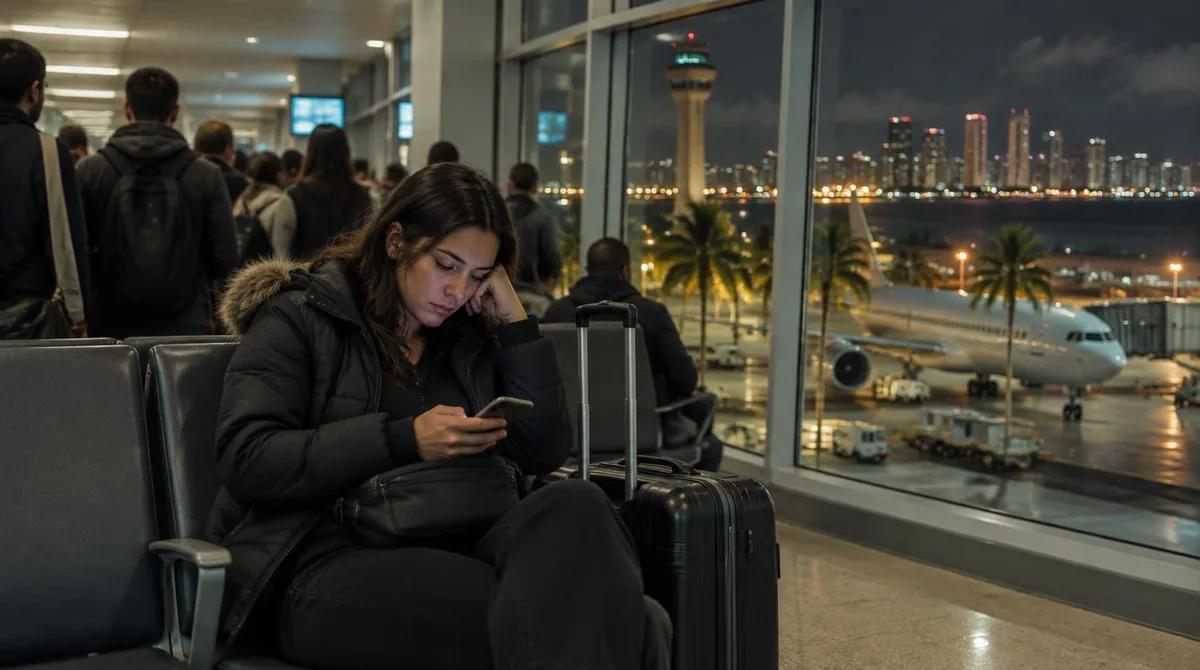
The Federal Aviation Administration put Miami International Airport on a ground stop at 8:16 p.m. EST Wednesday after a FedEx cargo plane overran the runway on landing. The stop lasted roughly two hours. Around 10:30 p.m., the FAA lifted it and switched to ground delays, which slow departures without halting them entirely. No injuries were reported.
For travelers, the timing did most of the damage. The incident came on Thanksgiving eve, and Miami ranks among the top five domestic destinations for holiday travel, according to the American Automobile Association. AAA has projected that 81.5 million Americans will travel at least 50 miles from home over a seven-day holiday period. A runway outage at a hub that size, on that night, converts a single incident into hours-long delays for people who never came near Miami.
Here is what happened, why the response was what it was, and what it signals for the rest of the holiday week. Readers tracking regional travel conditions can follow our ny-news coverage for the New York decisions and disruptions that reach the Hudson Valley. This connects to our earlier piece, How to watch News 12 Hudson Valley on any screen.
What is a ground stop, and why did the FAA use one?
A ground stop is the FAA's bluntest scheduling tool: it holds flights bound for a specific airport at their departure points, so aircraft do not take off toward a destination that cannot receive them. That matters more than it sounds. Without a stop, planes already airborne would circle or divert, and aircraft still on the ground would launch into a queue with nowhere to land.
In this case, the trigger was physical, not procedural. FedEx Flight 910, arriving from Memphis, overran the runway Wednesday evening. According to the airport, all but one runway closed for a brief period. With capacity cut to a fraction, the FAA had little choice but to pause inbound traffic until the scene was clear. An FAA source confirmed the airline and the reason for the stop, as reported by the Washington Examiner.
The two-hour window is the tell. A ground stop that ends the same night means the airport recovered its runways quickly. The FAA then moved to ground delays, a softer measure that meters traffic rather than freezing it. That sequence — stop, then delay — is the standard escalation ladder working in the right order.
Why did the plane run off the runway?
Nobody has said definitively, and the FAA is investigating. What is on record is weather. An airport employee who spoke anonymously to CBS News, the BBC's US partner, described rain and wind so heavy that the crew "just couldn't stop in time" and veered off into the grass. FedEx, in a statement to CBS12, confirmed only that Flight 910 "experienced an issue upon landing," that the crew was safe, and that it was coordinating with investigating authorities.
That gap between what an airline says and what an investigation eventually finds is normal, and readers should hold both lightly until the FAA reports. Wet runways and gusting wind are exactly the conditions that make landing distances hard to judge, but the cause is the investigator's finding to make, not ours.
How bad was the disruption?
Bad, and worse because of the calendar. CBS reported that some Thanksgiving travelers were delayed by several hours. Early Thursday morning, the tracking site FlightAware counted several hundred delays and cancellations affecting flights within, into or out of the United States. The day before, it had logged more than 6,800 delays and more than 160 cancellations nationwide.
The arithmetic of a hub closure works against late-night passengers in particular. When a stop ends at 10:30 p.m., the aircraft and crews that were supposed to fly the next morning are often out of position. The delays do not end when the stop does; they bleed into the following day. Travelers flying out of the Hudson Valley on connecting itineraries through southern hubs should assume less slack than the schedule shows, a pattern we also cover in our guide to how Hudson Valley school closings and delay calls happen — different institutions, same principle: the call cascades from conditions on the ground.
What comes next for holiday travel?
The weather, not the runway, is the larger story. The FAA had already warned that delays were possible "throughout the week" because of severe weather. The National Weather Service has forecast a strong coastal storm for the East Coast, bringing high winds, heavy rainfall and major coastal flooding on both sides of Thanksgiving Day. A series of Pacific storms is expected to bring rain, mountain snow and strong winds to the West Coast.
For anyone flying this week, the practical read is straightforward. The Miami ground stop was resolved within hours, but the conditions that likely contributed to it — rain and wind — are forecast to persist across both coasts through the holiday. Check flight status before leaving for the airport, and expect the national delay count to stay elevated regardless of what happens in Miami. The FAA's investigation into Flight 910 will answer the question the sources so far leave open: what, exactly, put a cargo jet in the grass on the eve of Thanksgiving.