Rockland County NY is the compact cluster of towns on the west bank of the Hudson River, sitting across from Westchester and just north of the New Jersey line. The county fits five towns, nineteen incorporated villages and seventeen hamlets into about 174 square miles, the smallest footprint of any county in New York outside the five boroughs. The 2020 census counted about 340,000 residents.
The ground explains the name. Rocky Palisades ridgelines drop toward the river along the eastern edge, and the land climbs west toward the hills around Harriman. County government works from New City, where the county clerk keeps an office on South Main Street, and each town runs its own government below the county layer.
The five towns of Rockland County NY
Ramapo covers the largest share of land in the west and north, and it holds the village of Suffern plus the busy corridors around Spring Valley and Monsey. Clarkstown sits at the center of the county, around New City, Nanuet and West Nyack, where the Palisades Center mall draws shoppers from across the region. Orangetown holds the southern half, from Piermont and Sparkill up through Pearl River, with the village of Nyack on the river itself. For related coverage, see Nyack NY: A River Village of Streets, Shops and Steep Views.
Haverstraw sits at the wide bay of the same name in the north, and Stony Point marks the county's northern tip. At Stony Point, a lighthouse first lit in 1826 still stands, and the county describes it as the oldest lighthouse on the Hudson River.
The river and the parkland
Bear Mountain State Park anchors the northwest corner. The park sits among rugged mountains that rise straight from the west bank of the Hudson, and its grounds hold the historic Bear Mountain Inn, picnic groves, fishing spots on river and lake, a merry-go-round and the Trailside Museums and Zoo, where resident bears remain the biggest draw. In winter, an outdoor rink opens on the same grounds.
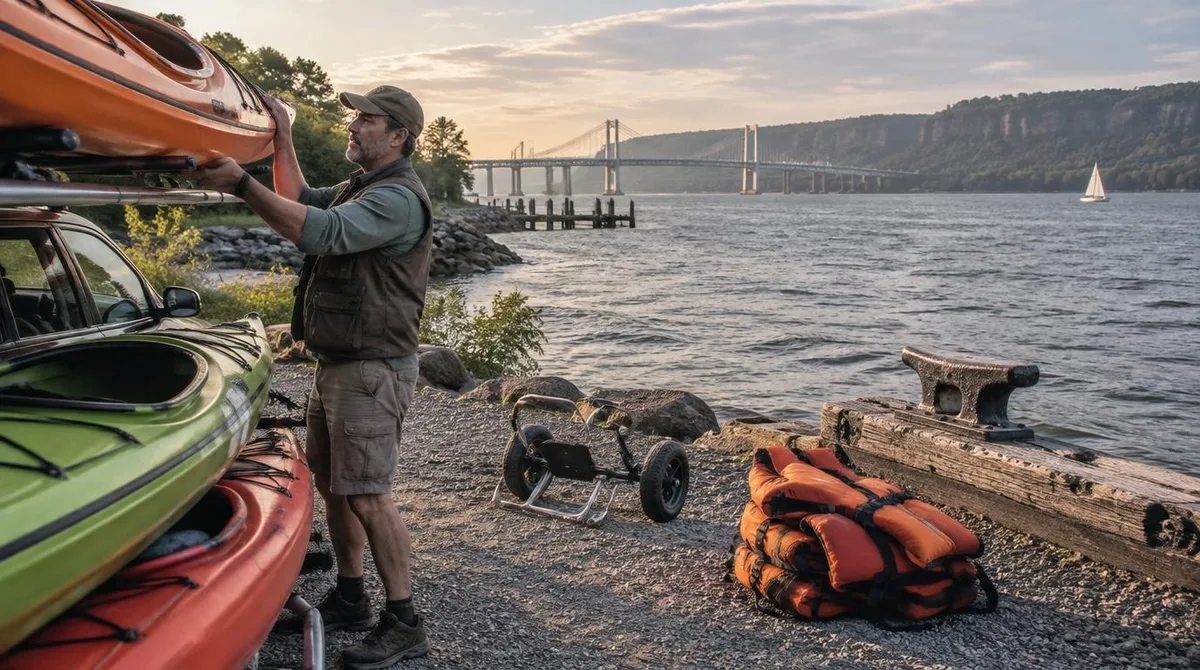
Farther south, Haverstraw Bay Park gives the county a front porch on the widest reach of the river, with a boat launch, fishing piers, walking paths, two playgrounds and the Rockland County September 11 Memorial. The county's open space program has added land to this network for years, which keeps the river shore unusually public for a suburb of New York City.
How Rockland County NY runs its daily life
Health care spreads across the county in three main hospitals, Montefiore Nyack, Good Samaritan and Helen Hayes. Higher education runs from Rockland Community College, the county's SUNY campus, to St. Thomas Aquinas College in Sparkill. Eight public school districts serve the towns, a small enough number that each one carries real weight in local identity.
Getting around depends on a few spine roads. The New York State Thruway crosses the county east to west, and the Palisades Interstate Parkway runs north from the state line through Bear Mountain. The county transportation department also coordinates buses, trains and a ferry link for commuters heading toward the city.
Libraries, senior centers and volunteer fire houses cluster in the same town centers, which keeps village life visible in places like Nyack, Pearl River and Suffern.
Farms, food and the fall calendar
Rockland County NY keeps a working farm belt despite its size. The Orchards of Concklin in Pomona, the county's oldest farm, has passed three hundred years of continuous operation and sells fruit from a farm store. Dr. Davies Farm in Congers runs apple picking, pumpkin picking and hayrides through the fall, and Cropsey Community Farm in New City tends five organic acres with shares sold through the Rockland Farm Alliance.
Baseball has a place here as well. Provident Bank Park in Pomona hosts the Rockland Boulders, an independent club that gives the county a summer night out of its own.
Conclusion: a small county with a river-scale life
Rockland County NY works because its pieces fit together tightly. Five towns share one river shore, one set of ridgelines and one commute shed, so a trip from Suffern to Piermont can pass lakes, quarries, malls and farm stands in under an hour. The county measures its history in lighthouses and orchards rather than monuments, and its residents measure it in school districts, hospital names and park entrances. For a place this small, the range of daily life runs wide, from bear enclosures at Bear Mountain to apple rows in Congers, all within sight of the Hudson. That mix of small scale and wide range is what residents mean when they call the county easy to live in and hard to leave.