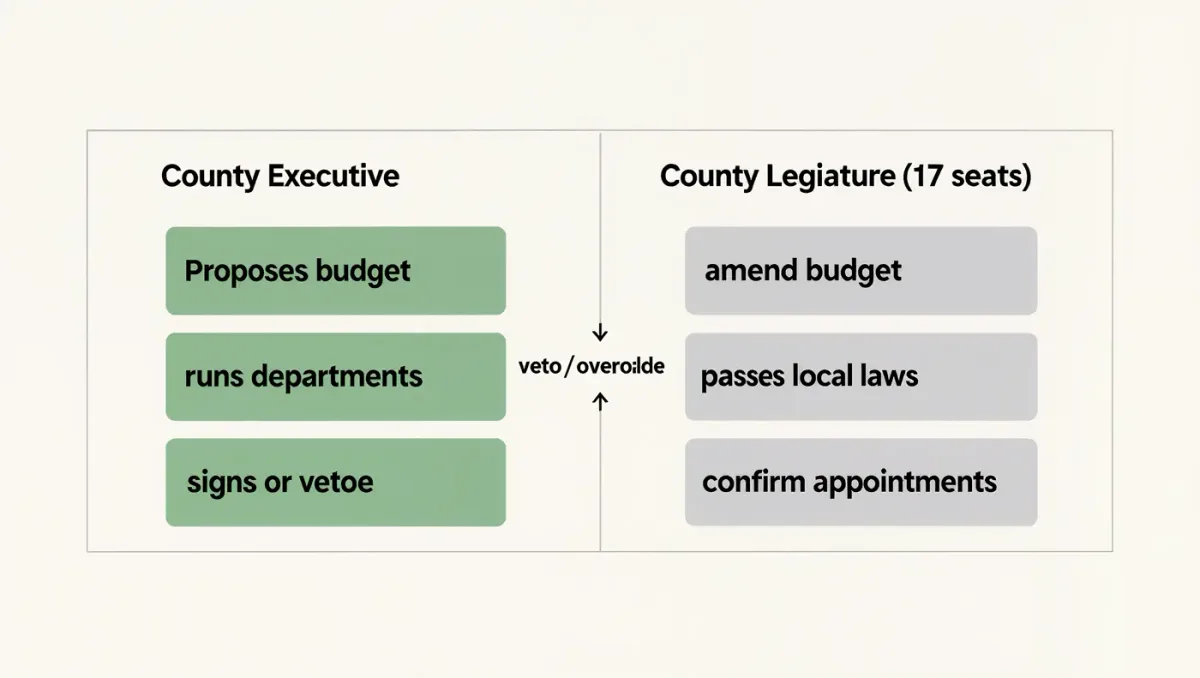
Rockland County property taxes are not set by one number on one day. They are the end product of a yearly cycle: a town assessor values your home, school districts and local governments set their budgets, the two are combined into a tax rate, and exemptions like STAR trim the bill before it ever reaches your mailbox. Understanding each step tells you where the bill comes from — and where you still have a say.
The county itself is small and densely settled. Rockland, the southernmost county on the west bank of the Hudson, held 338,329 residents at the 2020 census, according to Wikipedia's profile of Rockland County, spread across five towns — Clarkstown, Haverstraw, Orangetown, Ramapo and Stony Point — with the county seat in New City. That geography matters for taxes because Rockland is a town-assessment county: the five towns do the valuing, and each runs its own calendar for the work.
This explainer walks the cycle in order, from valuation to grievance to exemption, without the jargon. Where a step carries a deadline, the rule is simple: confirm the exact date with your town assessor's office or the county, because dates shift with the calendar and with state law changes.
What does an assessor actually do with your property?
Every year, the town assessor's office estimates what your parcel would sell for on a set valuation date. That estimate is the assessment. In New York, assessments are supposed to track a uniform percentage of market value, and many towns assess at full market value — meaning a house worth $500,000 on paper carries a $500,000 assessment. This connects to our earlier piece, Where Is Hudson Valley New York and Where Does It End.
The assessor works from property data: sales of comparable houses, the home's size and age, its condition and any permits pulled for renovations. A new deck or a finished basement can move the number. So can a revaluation, the periodic town-wide reset that brings stale assessments back in line with the market. When a town revalues, some assessments rise sharply and some fall; the town's total tax levy does not automatically rise with them.
What this means for a homeowner: your assessment is not your tax bill. It is one ingredient. The other ingredient — the tax rate — is set separately, by the bodies that spend the money.
Who sets the rate, and why school budgets dominate the bill?
Once assessments are in place, the taxing jurisdictions set their budgets. In most of Rockland, those are the school district, the town, the county, and often a village and special districts for fire, sanitation or lighting. Each jurisdiction takes the revenue it needs from property, divides it by the total taxable assessed value in its roll, and produces a tax rate.
School taxes are usually the largest slice, which is why the school-budget vote each spring is the single most direct lever a resident holds over the bill. The rest of the rate is set by town boards, the county legislature and village boards during their budget seasons.
Here is the part that surprises people: if every assessment in town doubled overnight, the tax rate would roughly halve, because the same levy would be spread over twice the assessed value. Your bill moves meaningfully only when your assessment changes relative to everyone else's — or when the levy itself grows. That is why a revaluation year feels turbulent even when the town insists it is revenue-neutral.
When can you challenge the assessment?
The challenge window is called grievance, and it is short. Each year, after the tentative assessment roll is filed, the town posts a Bar Date — the deadline to file a formal grievance with the town's Board of Assessment Review. Miss it and you generally wait a year for the next window.
Filing is free and does not require a lawyer. You submit the town's grievance form describing why you believe the assessment exceeds your home's market value: recent sales of comparable homes, condition problems, or a bad measurement on the record. The board reviews the paperwork and, in many towns, hears brief in-person or written arguments before issuing a decision on the final roll.
If the board denies the grievance, the next step is a Small Claims Assessment Review petition (for most one- to three-family homes) or a tax certiorari case in State Supreme Court. Each path has its own filing fees and deadlines, counted from the filing of the final roll.
Practical steps worth taking before you file:
- Get a copy of your property record card from the assessor and check the measurements and description against your actual house.
- Pull recent sale prices for similar homes in your hamlet — same school district, similar lot and vintage.
- Note the tentative roll posting date and the Bar Date for your town, and calendar both.
- Photograph anything the record gets wrong: a porch that never existed, a half-finished interior listed as finished.
One caution from anyone who has watched these hearings: a successful grievance lowers the assessment, not the budget. The saving shows up in your bill only in proportion to the reduction.
How does STAR change the bill?
STAR — the School Tax Relief program — is New York's statewide exemption on the school portion of the bill. It comes in two forms. Basic STAR is for owner-occupied primary residences below an income threshold set by the state; Enhanced STAR is for homeowners of qualifying age with lower incomes, and it delivers a larger benefit. In many Rockland districts, STAR arrives as a credit on the school tax bill rather than an exemption printed on the roll, but the effect on the wallet is the same direction.
Registration matters. New homeowners must register with the state Tax Department to receive the benefit, and Enhanced STAR recipients re-enroll periodically to confirm income eligibility. If you buy a house in Rockland and the school bill arrives with no STAR credit, the most common cause is simply that no one registered.
Other exemptions exist — veterans, seniors, disability, and in some towns solar or historic exemptions — each with its own application through the assessor. Unlike grievance, these are applications, not challenges: you qualify or you do not.
What this means for Rockland homeowners
Our analysis of the cycle comes down to three dates and one form. The tentative roll tells you what the town thinks your house is worth. The Bar Date tells you how long you have to disagree. The school-budget vote tells you who is spending the largest share of your money. STAR registration, once, takes care of the biggest standing exemption most households will ever claim.
None of these steps requires leaving the county. Assessors' offices in New City, Haverstraw, New Hempstead and the rest of the five towns handle records, grievance forms and exemption applications directly, and the county and state publish the underlying rules. The cycle rewards the homeowner who reads the tentative roll the week it posts, rather than the one who opens the bill in September and wonders where the number came from. Readers following this should also see Rockland County NY: Five Towns, One River and a Working Landscape.
For more on how the county's towns and villages fit together, see our guide to Rockland County's five towns, or follow county decisions in our Rockland News section.