That pothole you hit on the way to the Palisades Center has an owner. So does the flooded ditch at the end of your street, the cracked sidewalk outside the pharmacy and the snowbank the plow left across your driveway. In Rockland County, road repair is not one government's job. It is a layered system, and the layer that owns the road decides who gets your complaint.
The short answer: look at the road, not the map. State routes carry numbered markers and belong to New York State. County roads carry blue-and-yellow county markers and belong to the county. Everything else — most residential streets — belongs to a town or a village. Once you know which layer owns the pavement, you know which phone number matters.
This guide walks through each layer, explains how complaints get routed, and offers a practical way to figure out who to call before the next storm or the next freeze-thaw cycle turns small cracks into real craters. For more county coverage, see our Rockland News section.
Why road ownership is split into layers
New York, like most states, divides its roads by who built them and who promised to keep them up. When a state route was laid out, the state took on its maintenance. When a county highway was designated, the county did. When a developer built a subdivision in New City or Spring Valley, the town or village that accepted the streets took on theirs. The pavement does not care who owns it, but the budget does — and so does the work order.
The split matters because the crews are different. Each level of government has its own highway department, its own equipment and its own paving season. A county crew cannot simply repave a village street, and a village crew cannot legally rebuild a state route. Jurisdiction is the first question any dispatcher asks.
It also matters for money. Road maintenance is funded differently at each level: state routes draw on state transportation budgets, county roads on the county budget, and town and village streets largely on local property taxes and state aid distributed through local governments. That is one reason a smooth state route can end abruptly where a town street begins — the funding streams, and the repaving schedules, are separate. Readers curious about how the property tax side of that funding works can read our explainer on How the Rockland County Property Tax Cycle Works: Assessment, Grievance and STAR. This connects to our earlier piece, How the Rockland County Property Tax Cycle Works: Assessment, Grievance and STAR.
What the state, county, town and village each handle
Here is the layer cake, from the top down.
- State routes. Numbered highways — the routes that cross town lines and carry through traffic — belong to the New York State Department of Transportation. The state handles repaving, signal repair, guardrails and major drainage on its routes. Complaints about state routes go to the DOT, not to the town you are driving through.
- County roads. Rockland County's highway department maintains the roads marked with county route markers. These are the arteries between the state highways and the local streets: the roads a plow driver knows by heart. Potholes, shoulders, county-owned bridges and culverts on these roads are county work orders.
- Town roads. Each of Rockland's five towns — Clarkstown, Haverstraw, Orangetown, Ramapo and Stony Point — runs its own highway department. Town crews handle residential streets, local snowplowing, storm drains along town roads and the day-to-day patching that keeps a neighborhood drivable.
- Village streets. Rockland's villages maintain their own streets where they have not delegated the work. A village resident's pothole report goes to village hall, not town hall, even when the village sits inside a town.
One honest caveat: responsibility can shift at the curb. Sidewalks, driveway aprons and the strip of grass between sidewalk and street are often the adjoining property owner's responsibility under local code, even though the road itself is public. That surprises people every winter. The exact rule varies by municipality, so the local code — not this article — settles the question on your block.
How a pothole complaint actually moves
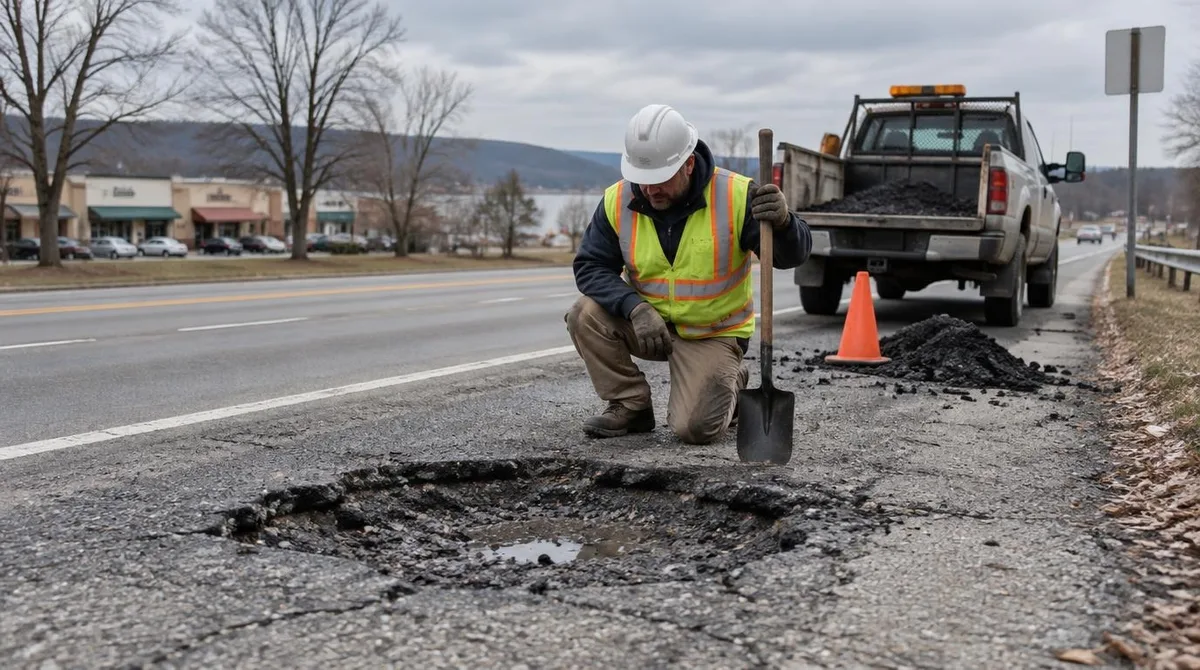
Say a pothole opens on your street after a wet week. The path it takes depends on where it sits.
If it is a town or village street, the report goes to the local highway or public works department, usually by phone or through an online form. A clerk logs it. A foreman may drive out to look. Small holes get patched from a truck; larger failures get scheduled for a proper repair. Priority tends to follow traffic and safety: an arterial road with a wheel-swallowing crater jumps the queue ahead of a quiet cul-de-sac with a shallow one.
If it is a county road, the report goes to the county highway department. If it is a state route, it goes to the DOT region that covers the county. The routing is the part most people get wrong — a call to town hall about a state route simply gets forwarded, or worse, politely lost.
Drainage complaints follow the same logic. A clogged storm drain on a county road is a county call; the same clog on a village street is a village call. Flooding that crosses property lines can pull in more than one agency, which is when patience helps more than insistence.
Worth noting what counts as a repair in the first place. The Free Dictionary defines "fix" as restoring something to proper condition or working order — to repair it. By that standard, a cold-patch shoveled into a pothole is a fix in the loosest sense: it restores the surface, briefly. Milling and repaving restores the road itself. Knowing the difference helps you ask the right question when you call: is this being patched, or scheduled?
Practical steps: figuring out who to call
Our analysis of how these complaints actually resolve comes down to one habit: identify the road before you dial. Here is a simple sequence.
- Look for a marker. A numbered route shield means state. A county route marker means county. No marker at all usually means town or village.
- Check your address. If you live in a village, village hall is the default first call for your own street. If you live in an unincorporated part of a town, the town highway department is.
- Note the location precisely. The nearest cross street, a house number, a landmark. "A pothole somewhere on Route 59" is much harder to dispatch than one pinned to a specific intersection.
- Describe the hazard, not just the nuisance. Depth, standing water, debris, a sight-line problem. Safety issues move faster than cosmetic ones.
- Ask for a reference. A complaint number or a work order reference lets you follow up without starting over.
If you are not sure which level owns the road, call your town hall anyway. Highway department staff route misdirected calls every day, and a polite "whose road is this?" usually gets a straight answer. The one thing not to do is assume the nearest government office is the right one — in Rockland, the nearest office is often the wrong one by one layer.
What this means for the county
The layered system works, most of the time. It also explains the frustrations residents raise at town board meetings every budget season: the smooth state road next to the rutted town road, the plow that stops at an invisible jurisdictional line, the pothole that takes three calls to land in the right inbox. None of that is neglect. It is the ordinary friction of a system where five towns, dozens of villages and two higher levels of government each own a piece of the same drive to work.
What the evidence of everyday practice supports is this: complaints that reach the right office with a precise location get handled faster than complaints that do not. What remains genuinely unknown, from street to street, is which layer owns it — and that is the one fact worth checking before the next storm rolls through the Hudson Valley. The rest is just pavement, and somebody's work order.